
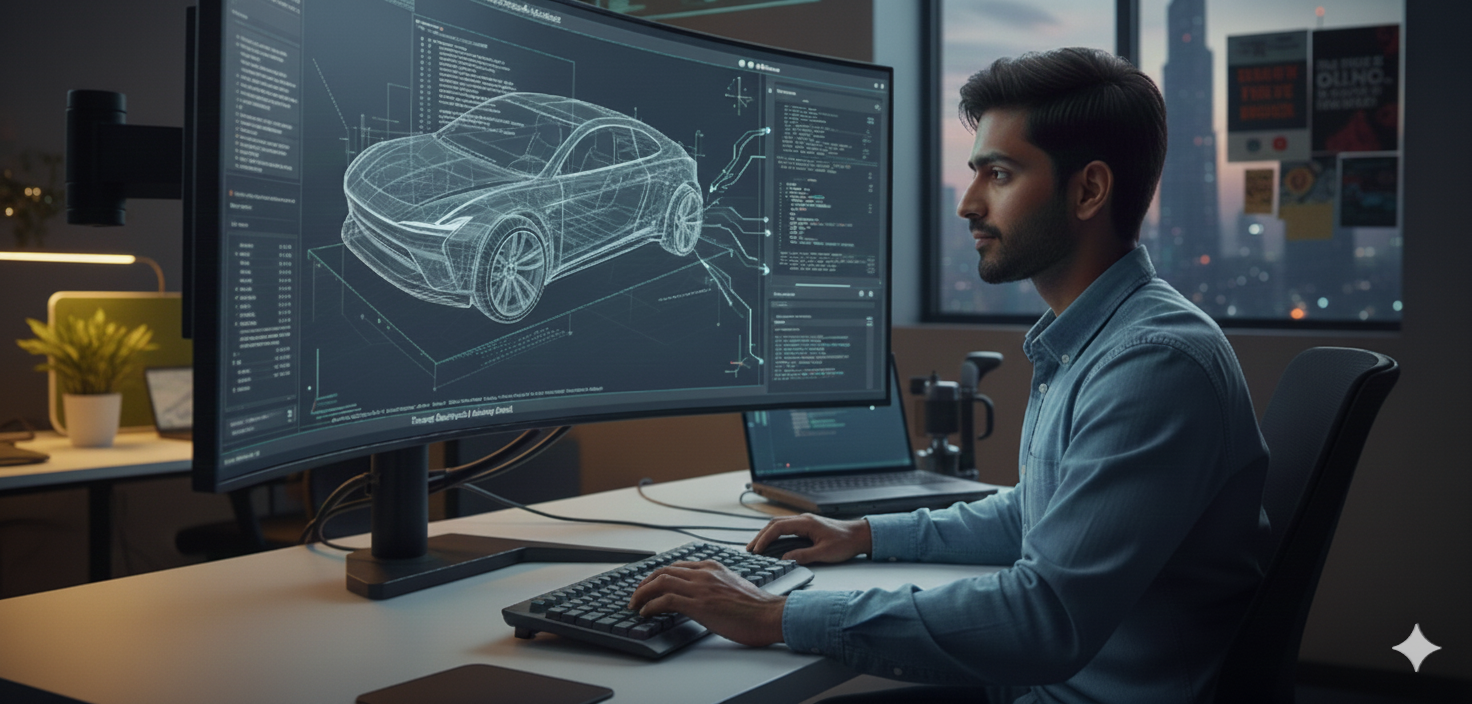
What is Digital Product
Engineering

Digital Product Engineering blends software, systems thinking, and mechanical expertise across the V-cycle. We use simulation, MBSE, digital twins, and advanced validation to accelerate development.

From faster prototyping to embedded EV integration, every detail we engineer drives excellence, safety, and sustainability.

1

Our Core Areas of Digital
Product Engineering

Creating Tomorrow’s Mobility with Virtual Precision & Real-World Rigor

Our Digital Product Engineering hub supports BMW’s R&D with simulation, CAD expertise, digital twins, and AI-driven automation, delivering vehicles that exceed expectations in safety, durability, comfort, efficiency, and performance.

Virtual Validation

We perform full-vehicle, sub-system, and component-level simulations to meet global performance and regulatory requirements in: Crash & Safety, Noise Vibration & Harshness (NVH), Durability & Fatigue, Computational Fluid Dynamics (CFD) and Multi-Body Dynamics (MBD), to ensure meeting regulation requirements worldwide.

Geometry, Concepts & CAD

Using cutting-edge tools, we develop high-precision CAD models across key mechanical domains: Geometrical Integration, Design of BIW, Exterior, Interior, Chassis and Powertrain.

Digital Twin & Product Data

We build high-fidelity digital twins that combine real-time test data with live design updates, providing a single source of truth across the vehicle lifecycle and enabling data-driven decision-making at every stage.

Methods, Tools and Programming

We implement AI/ML-driven automation and advanced scripting to: data analysis and product data creation. Develop industry-first methods that enhance design, performance, and customer satisfaction.

Compliance & Regulatory Readiness

We integrate safety, sustainability, and emissions regulations
from the earliest design phases, ensuring global readiness without retrofits or delays. Every product is built to meet or exceed international compliance standards.

Careers in Digital
Product Engineering

From virtual validation to digital twins, every line of code and CAD model you create helps shape the future of mobility. At BMW TechWorks India, you’ll work at the intersection of software and product innovation, engineering systems that perform flawlessly in the real world.

  • Automotive Vehicle Integration
  • Functional Design and Integration Exterior
  • Class A Surface Architect (Poly Modelling)
  • Mass Package Engineer
  • Lead Engineer – BIW Framing & Roof
  • FEM Simulation Expert – Crash / Pedestrian Protection
  • Simulation Engineer – CFD
  • Simulation Engineer – NVH

Explore open roles in Digital Product Engineering and bring your expertise to a global stage.

Explore Careers

FAQs

Q. Will I get to work on physical prototypes or only virtual models?

plusminus

Primarily virtual. We focus on reducing time and cost by creating robust digital models and simulations, but your work will influence real-world products.

Q. Do we follow agile methodologies here?

plusminus

You will work at the intersection of hardware and software, directly influencing how BMW vehicles are engineered, tested, and brought to market, digitally.

Q. What technique is used to build the models in Virtual Validation (CAE) department?

plusminus

The virtual validation models are built using FEM (Finite Element Analysis) method.

Q. What are different vehicle design attributes which are refined in Virtual Validation team of DPE?

plusminus

Five main performance attributes of a car design that are refined in Virtual Validation team are –
1. NVH (Noise Vibration Harshness)
2. Durability & Fatigue
3. Vehicle Crashworthiness / Safety
4. CFD (Computational Fluid Dynamics)
5. MBD (Multi-Body Dynamics).

Q. Is there an opportunity for programming (IT) background engineers in DPE?

plusminus

Yes, Methods, Tools and Programming department of DPE works on implementation of automation techniques, scripting for data analysis etc. which requires programming engineers.